

What Changed — and Why BPO Companies Should Pay Attention
The prediction is no longer speculative.
Gartner’s latest forecast states that by 2029, agentic AI will autonomously resolve 80% of common customer service issues without human intervention — driving a 30% reduction in operational costs. McKinsey’s 2025 Global Survey confirms the momentum: 62% of organizations already use or experiment with AI agents, with nearly a quarter scaling them across at least one function.
For businesses that outsource customer operations — and for the BPO companies that serve them — this creates a fundamental question: does AI replace the outsourcer, or does the outsourcer become the AI provider?
The answer, backed by $60 million in documented savings and thousands of enterprise deployments, is clear. The BPO companies that survive the next three years won’t be the ones fighting AI. They’ll be the ones deploying it.
The Numbers Are No Longer Theoretical
The AI-in-BPO market is projected to explode from $2.6 billion today to $49.6 billion by 2033 — a 34.3% compound annual growth rate. That’s not a forecast for a niche tool. That’s a forecast for the entire industry’s operating model shifting.
Real deployments are already proving this out:
Klarna — the Swedish fintech giant — deployed an AI assistant that now handles two-thirds of all customer service inquiries. The equivalent of 853 full-time agents. Their IPO filing documented $60 million in cumulative cost savings by Q3 2025. Per-transaction customer service costs dropped 40% over two years, from $0.32 to $0.19 per interaction. Response times improved by 82%, from 11 minutes to under 2 minutes.
IBM’s 2025 study found companies using AI voice assistants saw a 31% drop in Average Handle Time and a 22% increase in First-Call Resolution — the two metrics that drive every BPO contract.
Sierra AI, built by former Salesforce co-CEO Bret Taylor, reached $100 million in annual recurring revenue in just seven quarters — one of the fastest enterprise software growth trajectories in history. Their customer OluKai saw 70% of inquiries resolved without human intervention.
Salesforce Agentforce crossed 12,500 customers in 39 countries, with users reporting over $100 million in collective annualized cost savings.
These aren’t pilots. These are production systems processing millions of interactions.
Why BPO Companies Should Be Excited, Not Threatened
Here’s where most industry commentary gets it wrong.
The Deloitte 2024 Global Outsourcing Survey of 500+ executives revealed a seismic shift in what drives outsourcing decisions. Cost as a primary driver dropped from 70% in 2020 to just 34% in 2024. The new top priorities:
- Access to talent (42%)
- Increasing customer demands (35%)
- Improved quality and performance (33%)
- Adoption of global delivery models (33%)
And critically: 83% of executives are now leveraging AI as part of outsourced services.
This means enterprise buyers aren’t looking for the cheapest call center anymore. They’re looking for technology-forward partners who can deploy AI alongside human agents, manage the transition, and deliver measurable CX outcomes.
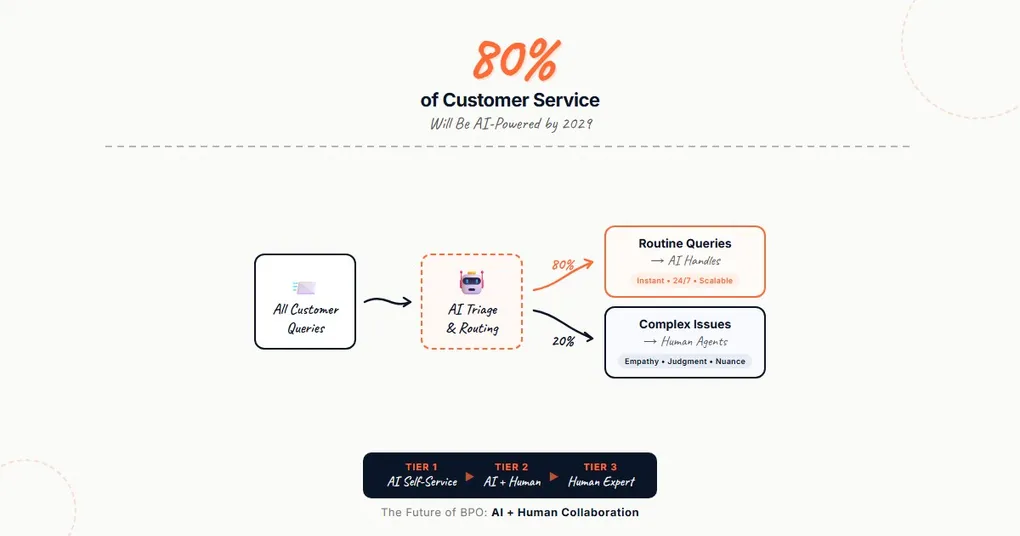
For a BPO company with deep regional expertise and enterprise clients, this is the opportunity of a lifetime. The companies that can offer AI-augmented customer experience — where AI handles the 80% of routine interactions while human agents focus on complex, high-value conversations — will command premium contracts.
The companies that can’t will compete on cost alone. And cost-only competition against AI is a race to zero.
The Reality Check: Why “Just Deploy AI” Doesn’t Work
Before anyone rushes to replace their workforce with chatbots, the failure data demands attention.
Gartner predicts over 40% of agentic AI projects will be canceled by 2027 due to escalating costs and unclear ROI. MIT’s NANDA initiative reported a 95% failure rate for enterprise AI pilots. And Klarna itself — the poster child for AI customer service — admitted it “overpivoted” on AI and began re-hiring human agents in May 2025.
The compound error problem is the mathematical ceiling. A 1% per-step error rate produces a 63% failure rate on 100-step tasks. Real-world agents misfire closer to 20%, making fully autonomous multi-step customer service resolution unreliable for anything beyond simple queries.
This is precisely where BPO expertise becomes irreplaceable.
A technology vendor can build an AI chatbot. But only an experienced BPO operation can:
- Design the escalation logic that routes the right 20% to human agents
- Train AI models on industry-specific terminology and compliance requirements
- Monitor quality across millions of interactions in real-time
- Handle the cultural nuances of serving government clients differently than retail clients
- Maintain ISO 27001 and GDPR compliance across AI and human touchpoints simultaneously
The winning model isn’t AI replacing BPO. It’s BPO becoming the AI delivery layer.
What the AI-Augmented BPO Model Actually Looks Like
The most successful deployments follow a clear pattern:
Tier 1: Full AI automation (60-80% of volume) Password resets, order status inquiries, appointment scheduling, FAQ responses with real-time knowledge base access, routine data collection, and post-interaction surveys.
Tier 2: AI-assisted human agents (15-25% of volume) AI listens to the conversation and surfaces relevant information in real-time. Suggested responses that agents can approve or modify. Automatic CRM updates and post-call documentation. Sentiment analysis flagging escalation needs before the customer asks.
Tier 3: Human-only complex resolution (5-15% of volume) Emotionally charged complaints requiring empathy. Multi-party disputes with legal or compliance implications. High-value account retention conversations. Culturally sensitive government interactions.
This tiered model delivers the cost reduction enterprises want while maintaining — and often improving — the quality metrics that BPO contracts are built on.
IBM’s data shows this hybrid approach delivers a 31% improvement in Average Handle Time without sacrificing First-Call Resolution. Bain & Company projects 60% of BPO contracts will include personalization metrics by 2027 — metrics that AI-augmented operations are uniquely positioned to deliver.
The GCC Opportunity Is Massive and Undertapped
The GCC BPO market reached $2.41 billion in 2024 and is growing at 10.1% annually. The UAE’s contact center outsourcing market alone is projected to reach $7.16 billion by 2030.
Dubai appointed 22 Chief AI Officers to key government departments in June 2024. The UAE’s national AI strategy aims to generate AED 335 billion in additional economic growth. Saudi Vision 2030 is driving unprecedented digital transformation across government services.
Yet most regional BPO companies are still competing on headcount and cost-per-seat.
The enterprise buyer in the GCC is already looking for AI-augmented outsourcing. 89% of buyers are seeking transformational impact from their BPO providers, according to KPMG and HFS Research. The average B2B buyer consumes 13 pieces of content before making a vendor decision — and 70% of the buyer journey is complete before they ever contact sales.
The BPO companies that position themselves as AI-powered customer experience partners — with real deployment data, not just marketing claims — will capture the premium segment of a market growing toward $7 billion.
The Bottom Line
The question isn’t whether AI will handle 80% of customer service. Gartner says it will. The enterprise deployment data confirms the trajectory. The economics are overwhelming.
The question is who manages that transition.
BPO companies that embrace AI as a force multiplier — deploying it alongside human expertise, maintaining quality oversight, and delivering measurable CX outcomes — will own the next decade of customer experience outsourcing.
Those that don’t will be replaced by the technology they refused to adopt.
The $49.6 billion AI-in-BPO market isn’t coming for BPO companies. It’s coming through them — but only the ones that move now.